
When AI Acts,
Governance Must Act With It.
Make AI Governable.
01 / The Assurance Layer for AI
Runtime Governance for High-Risk AI Systems
Piscys is building an independent control layer between AI systems and consequential action. For consequential AI, governance must control not only what the system may do, but who is authorized to decide when the stakes change.
Designed for CISOs, risk leaders, and counsel, the platform aims to reduce operational risk and strengthen oversight of high-consequence AI.
Available Now — Executive briefings, readiness assessments, and implementation design for high-risk AI workflows.
Platform capabilities remain in development.
Schedule an Executive Briefing — explore how Piscys can govern high-risk AI.
Documentation
iS NOT
Control
02 / Measure What Matters
From Governance Intent to Control Evidence
When AI takes a consequential action, who is authorized to intervene, override, approve, or accept the remaining risk — and what evidence proves that authority was exercised correctly?
Piscys is being designed to help enterprises answer those questions — and assess whether their safeguards are working.

AI Trust Metrics
Designed to quantify runtime governance through Exposure Minutes, intervention timing, override patterns, and control health — showing whether safeguards are responding as intended.
Measure how quickly governance contains risk.
Exposure Minutes
Piscys’ primary operational metric for how long material AI risk remains active before accountable containment — giving teams a clear measure of governance responsiveness.
Reduce the time risk remains exposed.
Assurance Dashboard
Designed to give security, risk, and executive teams a shared view of significant events, interventions, unresolved issues, accountable decisions, and supporting evidence. Identifies where attention is needed.
Bring the right decisions into view.
Control & Framework Mapping
Designed to connect controls and evidence to NIST AI RMF, ISO/IEC 42001, the EU AI Act, and relevant requirements. Helps teams connect internal safeguards to external expectations and audits.
Connect oversight to external expectations.
03 / Inside The Platform
Three Engines.
One Governance Loop.
The platform architecture connects records of AI activity, proportionate safeguards, and accountable decision authority through three coordinated engines.
Provenance Engine: Auditable Action Ledger
Intervention Engine: Active Safeguards
Custody Engine: Governed Authority
04 / Shared Evaluation Layer
Constraint Polyphony Connects the Governance Loop

Constraint Polyphony is Piscys’ shared evaluation method for consequential AI actions. Across Provenance, Intervention, and Custody, it examines the same action through multiple independent lenses — including evidence quality, proportionality, and decision authority — to assess what is supported, what response is warranted, and who is authorized to decide.
Those evaluations feed AI Trust Metrics and the Assurance Dashboard — translating runtime governance into measurable signals that help security, risk, and executive teams see whether safeguards are working, how interventions are being applied, and where accountable human authority enters the loop.
05 / Healthcare Concept Prototype
Explore the Governance Experience
Illustrative scenario and metrics. Platform in development — advisory services available now.
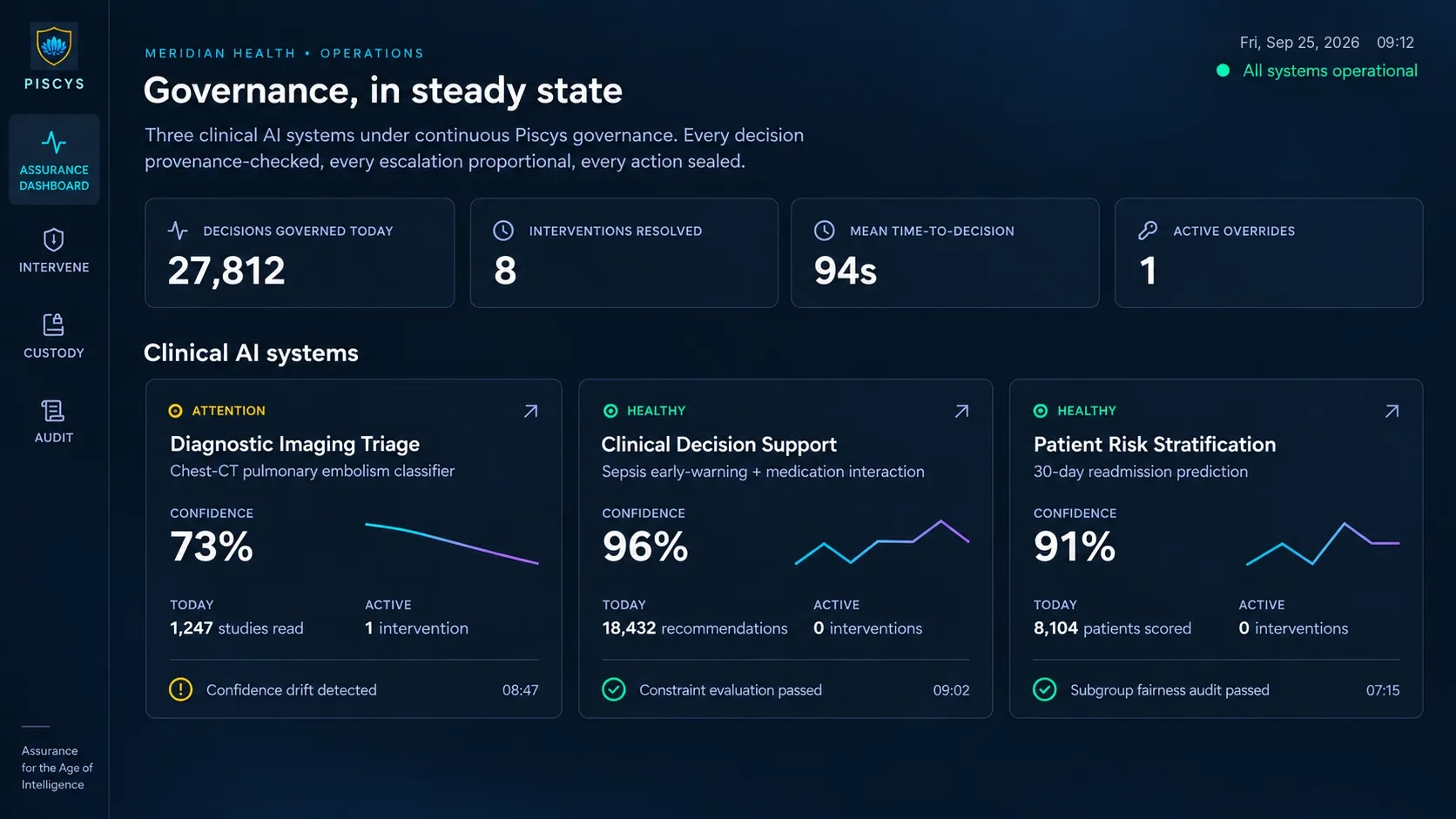
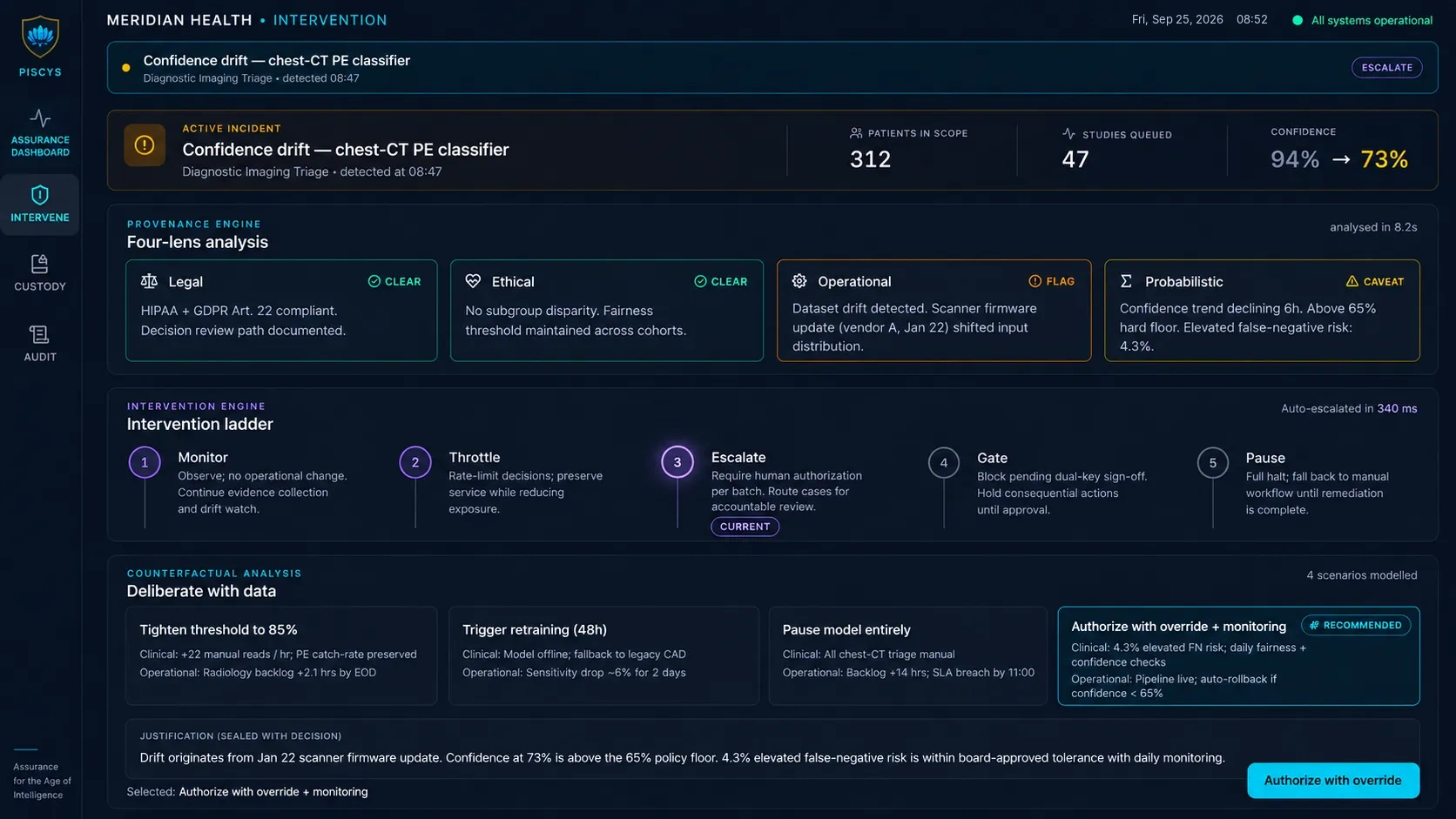
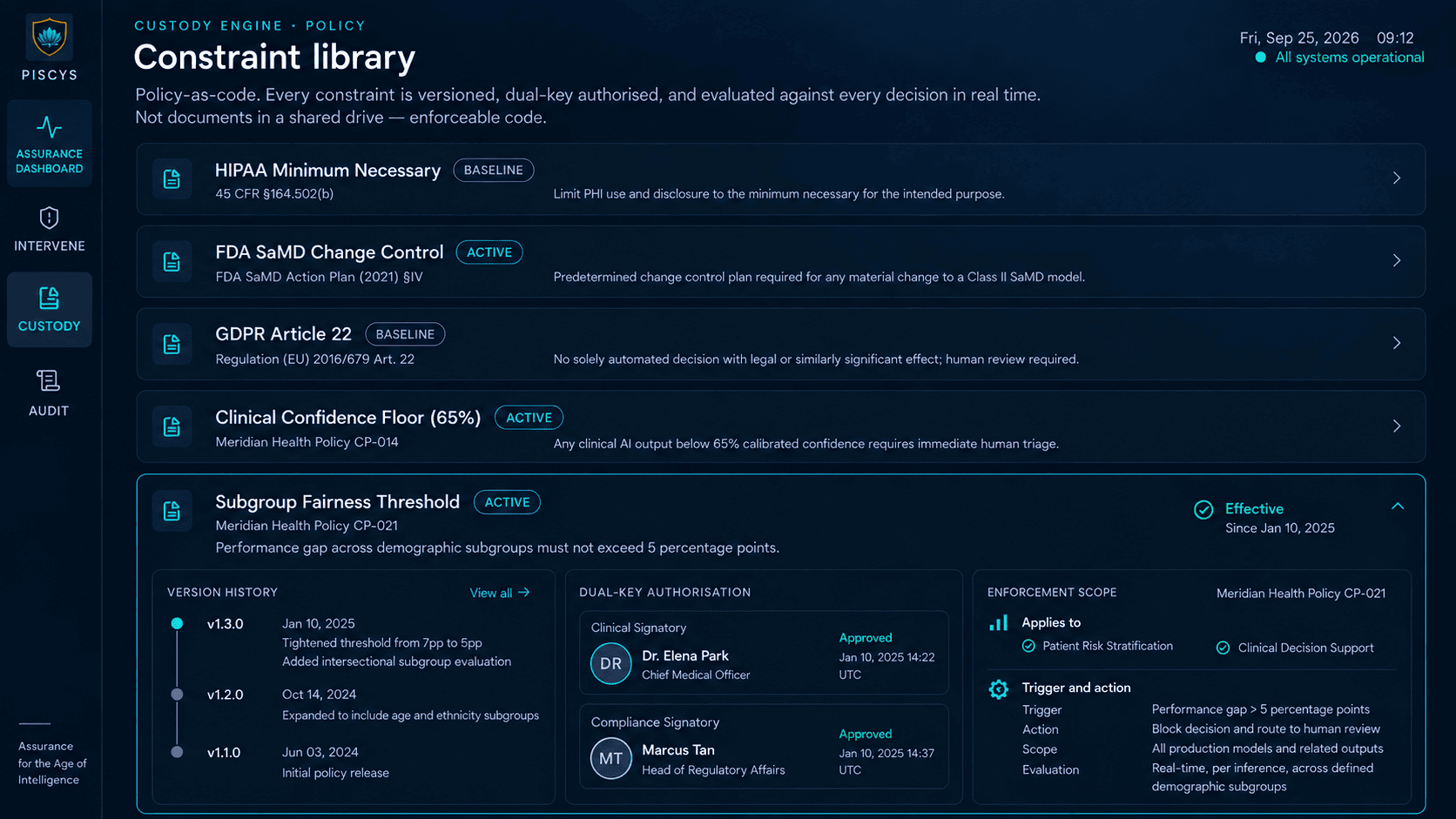
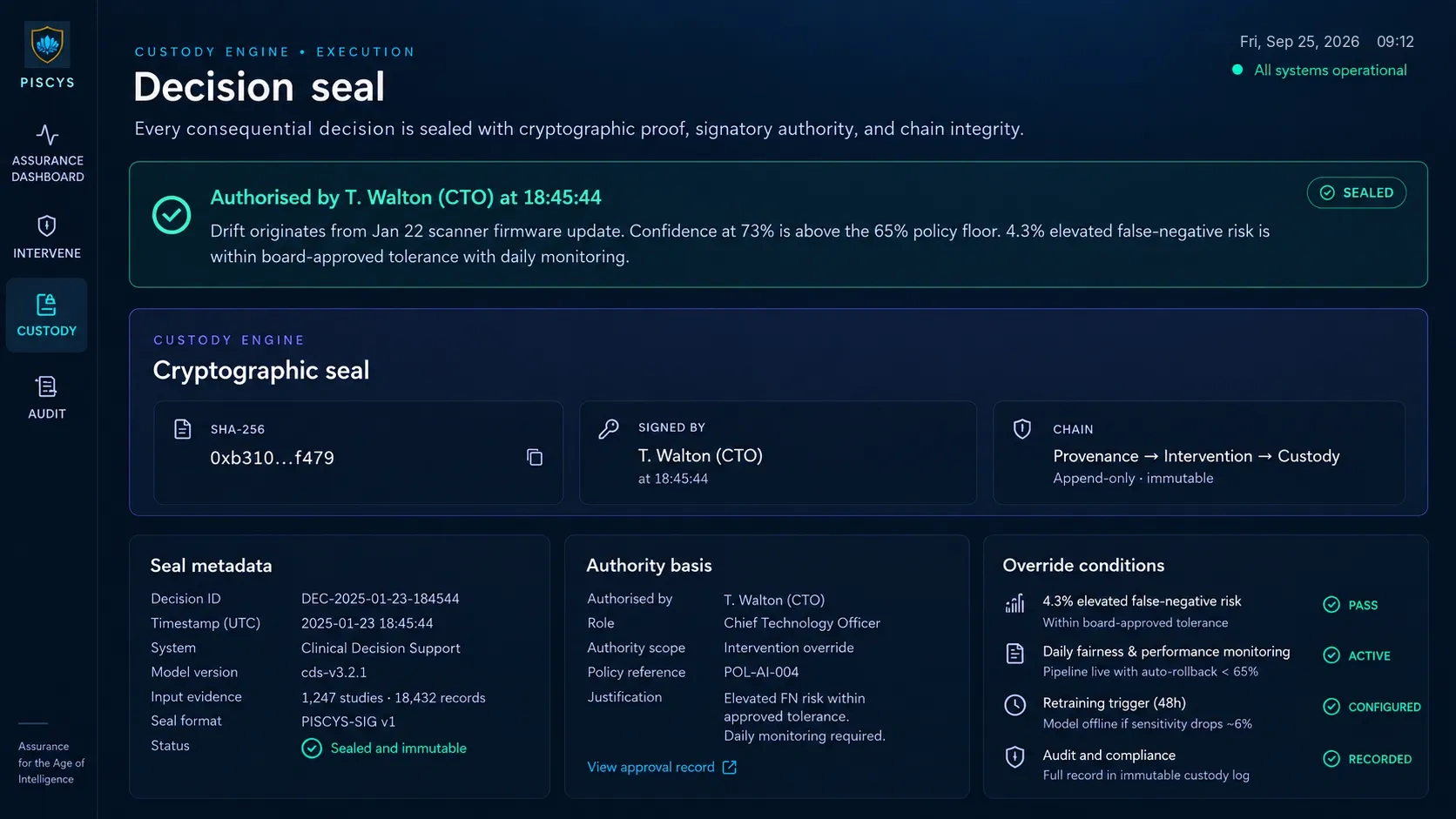
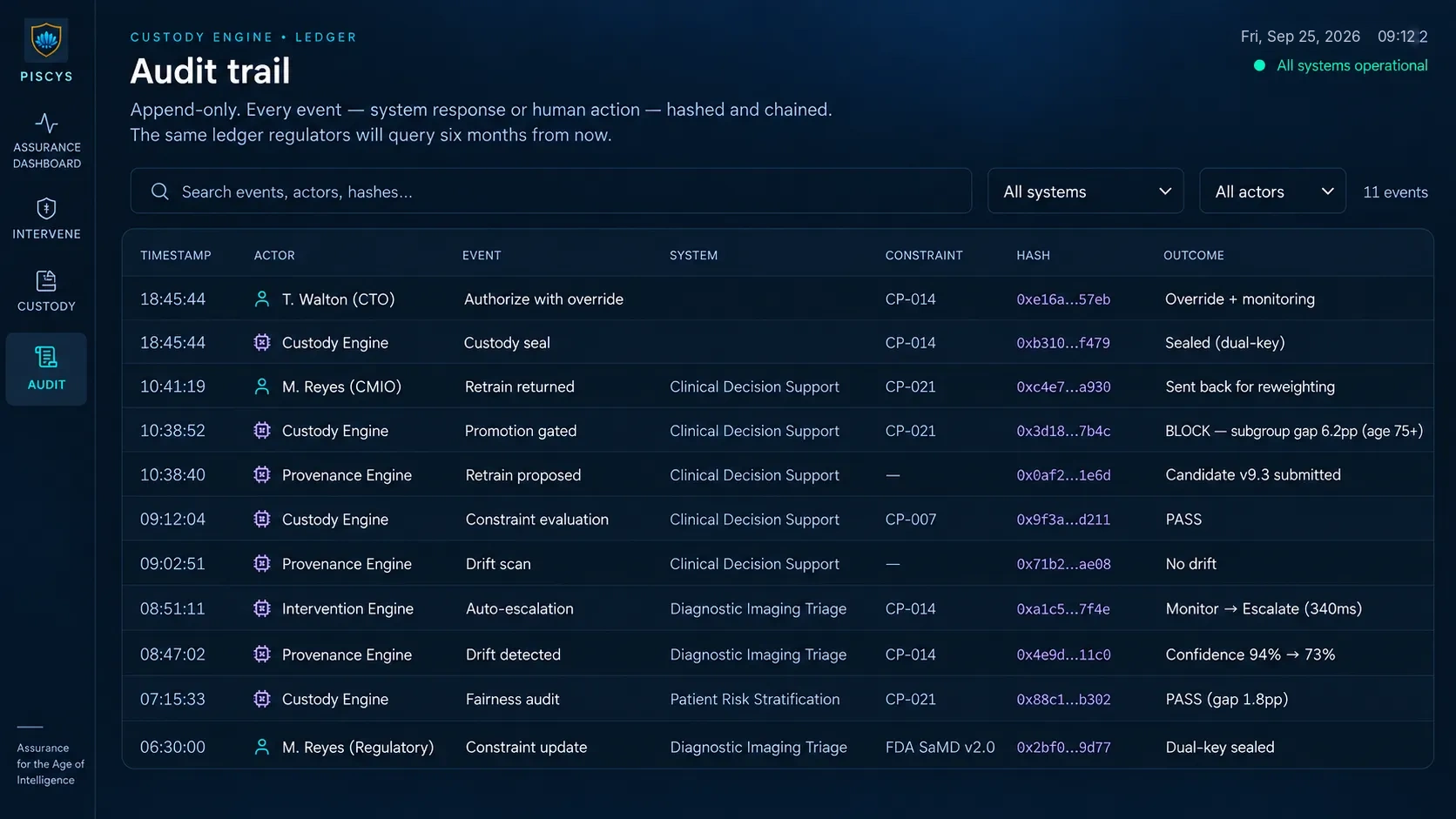
Select a capability to explore. Click any screen to enlarge.
06 / Design Partner Opportunities
Are You Building or Deploying AI in a Regulated Environment?
Work with Piscys to identify oversight gaps in a priority AI workflow, define intervention and approval requirements, and shape assurance capabilities around your operational needs.
We are seeking design partners in financial services and healthcare.
Our Initial Focus
Financial Services
Healthcare
07 / Our Approach
Operational Governance Across the AI Lifecycle
Piscys’ approach is informed by the four functions of the NIST AI Risk Management Framework: Govern, Map, Measure, and Manage. Governance informs every function as systems, risks, and operating conditions change.
Govern
Define accountable roles, risk tolerances, approval authority, and escalation policies that guide oversight throughout the AI lifecycle.
Map
Identify the workflow, systems, data, and affected stakeholders to understand where consequential risks may arise.
Measure
Assess identified risks and evaluate safeguards using relevant metrics, testing, and documented findings.
Manage
Prioritize responses, apply proportionate controls, and monitor residual risk as systems and operating conditions change.
08 / Our Network
Ecosystem
Strategic programs, technology ecosystems, and industry relationships supporting Piscys’ development and market readiness.
NVIDIA Inception Program
A global startup ecosystem supporting companies building innovative AI technologies.
Piscys is a member of the NVIDIA Inception Program.
09 / Contact Us
Let's Discuss Your AI Governance Priorities
Request a founder-led executive briefing to discuss a consequential AI workflow, identify oversight gaps, and explore practical next steps.
For design partnerships or other inquiries, tell us what you have in mind.